
Why Sleep and Mental Health Are Closely Linked
Understanding the Connection Between Sleep and Mental Health
How Sleep Quality Shapes Emotional Well‑Being
Kelly-Johnston Counseling, Conroe Texas
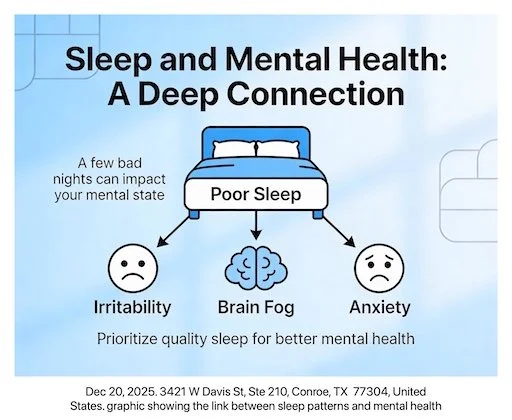
If you've ever felt more irritable, foggy, or anxious after a few bad nights, you're not imagining it — sleep and mental health conroe tx, are deeply entwined. Improving sleep often helps mood, and improving mood often helps sleep. This article explains why, summarizes what the science says, and gives practical steps you can try tonight to support your emotional well‑being.
1. Why Sleep and Mental Health Are Closely Linked
Sleep is not a passive state. It is a time when the brain resets, consolidates memories, and balances neurotransmitters that influence mood and cognition. Understanding the sleep mental health conroe tx connection starts with biology and scales up to clinical implications.
1.1 The biological basis of the sleep mental health conroe tx connection
- Circadian rhythms, neurotransmitters, and brain recovery
The brain operates on a roughly 24‑hour circadian rhythm regulated by the suprachiasmatic nucleus. Light exposure, mealtimes, and activity help synchronize this rhythm. During sleep, waves of neural activity help clear metabolic waste (including beta‑amyloid), restore neurotransmitter balance (serotonin, dopamine, norepinephrine), and recalibrate stress circuits. Disrupted sleep timing or quality interferes with these restorative processes, increasing vulnerability to mood dysregulation. - How sleep stages influence emotional regulation
Sleep proceeds through stages: light sleep, deep slow‑wave sleep (SWS), and rapid eye movement (REM) sleep. SWS supports physical recovery and immune function; REM sleep helps process emotional memories and regulate affect. Insufficient REM or fragmented sleep can impair emotional memory consolidation and lead to heightened reactivity or flattened mood the next day.
(LSI terms: circadian disruption, REM processing, slow‑wave sleep, neurotransmitter homeostasis)
1.2 Epidemiology: who is affected and how often
- Statistics linking poor sleep to mental health conroetx, disorders
Short or poor sleep is common: in the U.S., roughly 1 in 3 adults report getting less than the recommended 7 hours per night. Insomnia symptoms affect an estimated 10–30% of adults, and chronic insomnia impacts about 6–10% of the population. Large cohort studies and meta‑analyses show that chronic sleep disturbance increases the risk of developing depression and anxiety disorders — often by about 1.5–2 times compared with people with healthy sleep patterns. - Populations at higher risk (adolescents, shift workers, older adults)
Adolescents commonly face delayed sleep phase and early school start times, producing chronic sleep restriction and higher rates of mood problems. Shift workers experience circadian misalignment that raises risk for depression and anxiety. Older adults may have fragmented sleep and medical comorbidities that compound mental health risk.
1.3 How clinicians conceptualize the bidirectional relationship
- Sleep problems as both cause and symptom of mental illness
Clinicians view the relationship as bidirectional: insomnia and poor sleep can precede, exacerbate, or maintain mood and anxiety disorders, while depression and anxiety commonly cause sleep disturbances. Treating one without addressing the other often leads to incomplete recovery. - Brief mention of diagnostic and treatment implications
Because of this link, mental health assessments now commonly include sleep screening. Addressing sleep problems early — for example with cognitive behavioral therapy for insomnia (CBT‑I) — can improve psychiatric outcomes and reduce relapse risk.
"Sleep disturbance should be seen as a modifiable risk factor in mental health care." — clinical guidance from sleep medicine and psychiatry consensus statements.
2. The Effects of Sleep Deprivation on Mood and Cognition
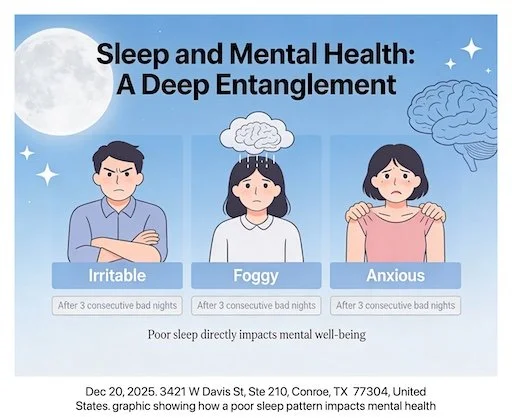
Sleep deprivation ranges from a single bad night to chronic partial sleep loss. Both have measurable consequences for emotion and thinking.
2.1 Short-term effects: irritability, concentration, and decision-making
Acute sleep loss causes:
- Irritability, low frustration tolerance, and emotional volatility.
- Slower reaction times, impaired attention, and poor concentration.
- Worse decision-making, particularly under stress or ambiguity.
Even one night of restricted sleep (e.g., 4–5 hours) reduces prefrontal cortex activity — the area responsible for impulse control and planning — and increases amygdala reactivity, which mediates emotional responses.
2.2 Long-term effects: chronic stress, decreased resilience, and psychiatric risk
- Chronic sleep loss elevates stress hormones such as cortisol and reduces resilience to daily stressors.
- Longitudinal studies link ongoing poor sleep with higher rates of mood disorders, cognitive decline, and reduced quality of life.
- Sleep fragmentation and short sleep duration are associated with increased risk of developing major depressive disorder and can worsen outcomes in those already diagnosed.
(Stat example: population studies show a consistent association between persistent insomnia and increased risk of depression onset within a few years; treating insomnia reduces this risk.)
2.3 The impact of sleep on depression and anxiety development
- Specific mechanisms linking sleep disturbance to depression
Sleep disruption alters monoamine neurotransmitter systems (serotonin, norepinephrine), impairs emotional memory processing, and increases inflammation — all mechanisms implicated in depression. Sleep loss also weakens social and cognitive functioning, reducing protective factors like social support and problem‑solving. - Overlap with sleep disorders and anxiety
Anxiety often causes hyperarousal, making sleep initiation and maintenance difficult. Conversely, insomnia can increase worry and rumination. Panic disorder, generalized anxiety disorder, and PTSD frequently present with disturbed sleep and nightmares, creating a feedback loop that sustains both conditions.
(LSI terms: hyperarousal, rumination, inflammatory markers, emotional memory consolidation)
3. Sleep Disorders, Anxiety, and Other Mental Health Conroe TX, Conditions
Recognizing specific sleep disorders helps tailor treatment and may improve both sleep and psychiatric symptoms.
3.1 Common sleep disorders linked to anxiety and mood disorders
- Insomnia
Characterized by difficulty falling asleep, staying asleep, or waking too early with daytime impairment. It commonly coexists with depression and anxiety and is a frequent treatment target. - Obstructive Sleep Apnea (OSA)
Recurrent airway collapse during sleep fragments sleep architecture, reduces oxygenation, and increases daytime sleepiness and mood disturbance. Untreated OSA associates with higher rates of depression and cognitive impairment. - Restless Legs Syndrome (RLS) and Periodic Limb Movement Disorder
These cause sleep fragmentation and can worsen mood and anxiety through chronic sleep loss.
How each disorder can exacerbate anxiety or depression:
- OSA: daytime fatigue and mood swings, plus shared vascular/inflammatory pathways.
- Insomnia: perpetuates worry and decreases coping skills.
- RLS: frustrates attempts to sleep, leading to anticipatory anxiety.
3.2 Comorbidity: diagnosing and treating dual conditions
- Challenges in assessment when sleep disorders and anxiety coexist
Symptoms overlap: fatigue, poor concentration, and sleep disturbance occur across many psychiatric and sleep disorders. Comprehensive assessment should include sleep history, screening questionnaires (e.g., Insomnia Severity Index, STOP‑BANG for OSA), and, when indicated, diagnostic testing like polysomnography. - Coordinated treatment approaches
Integrated care models that combine CBT‑I, psychotherapy for anxiety/depression, and medical treatments (e.g., CPAP for OSA) yield better outcomes than treating either condition alone. For example, treating OSA with CPAP often improves mood and cognitive function; treating insomnia with CBT‑I reduces depressive symptoms and lowers relapse risk.
3.3 When to seek professional help
- Red flags and referral guidelines for clinicians and patients
Seek evaluation if:- Sleep problems persist for more than 3 months despite good sleep hygiene.
- Daytime impairment (work errors, accidents, severe fatigue) occurs.
- There is suspicion of OSA (loud snoring, witnessed apneas, excessive daytime sleepiness).
- There are suicidal thoughts, severe mood changes, or psychotic symptoms.
If symptoms persist, consult:
- Primary care provider (first step in many English‑speaking health systems).
- Sleep medicine specialist (for suspected OSA or complex sleep disorders).
- Mental health conroe tx professional (for anxiety, depression, PTSD) who coordinates care.
(Links: American Academy of Sleep Medicine, [CDC sleep health][1])
4. Improving Sleep for Mental Wellness: Strategies and Interventions
Improving sleep for mental wellness requires a mix of behavioral, medical, and lifestyle interventions. Below are evidence‑based options.
4.1 Evidence-based behavioral interventions
Cognitive Behavioral Therapy for Insomnia (CBT‑I)
CBT‑I is first‑line treatment for chronic insomnia and includes components such as cognitive restructuring, sleep restriction, stimulus control, and sleep hygiene. Meta‑analyses show durable benefits and mood improvement after CBT‑I.Relaxation, stimulus control, and sleep restriction techniques
Practical techniques:- Stimulus control: use the bed only for sleep and sex; leave bed if unable to sleep for 20 minutes.
- Sleep restriction: limit time in bed to increase sleep drive, then gradually increase as efficiency improves.
- Relaxation training: progressive muscle relaxation, guided imagery, or diaphragmatic breathing.
(Practical note: Many CBT‑I programs are available in person, via telehealth, or through validated digital platforms in the UK, US, Canada, and elsewhere.)
4.2 Medical and technological options
- Pharmacological considerations
Short‑term hypnotics or sedating antidepressants may be appropriate for acute insomnia but are not ideal as long‑term monotherapy. Discuss risks and benefits with a clinician. - CPAP for sleep apnea
Continuous positive airway pressure (CPAP) remains the gold standard for moderate–severe OSA and often improves mood and daytime function when used consistently. - Role of apps, wearables, and telehealth in monitoring sleep quality
Consumer wearables and smartphone apps can track sleep patterns and provide insights but vary in accuracy. Actigraphy or polysomnography are gold standards for clinical diagnosis. Telehealth expands access to CBT‑I and sleep specialists.
(LSI terms: sleep tracking, actigraphy, telemedicine, hypnotics, CPAP adherence)
4.3 Lifestyle changes that support mental wellness through better sleep
- Exercise: Regular moderate aerobic exercise improves sleep latency and depth; aim for most days of the week but avoid intense workouts close to bedtime.
- Nutrition: Limit heavy meals and alcohol near bedtime; alcohol fragments sleep despite initial sedation.
- Screen time limits: Reduce blue light exposure 60–90 minutes before bed; use night modes if needed.
- Stress management: Mindfulness, journaling, and problem‑solving earlier in the evening can reduce bedtime rumination.
(Practical example: shifting evening news or social media sessions earlier in the evening and taking a brisk 30‑minute walk in the late afternoon often yields measurable sleep benefits.)
5. Practical Sleep Hygiene Techniques to Boost Emotional Health
Good sleep hygiene supports the strategies above and is often the first step for most people.
5.1 Daily routines and environmental adjustments
- Consistent sleep schedule: Wake up and go to bed at roughly the same time daily — even on weekends. This stabilizes circadian rhythms.
- Bedroom environment: Keep the room cool (about 60–67°F / 15–19°C), dark, and quiet. Use blackout curtains and consider white noise if noise is disruptive.
- Light management: Get bright light exposure in the morning to anchor your circadian rhythm; minimize bright light and screens in the evening.
5.2 Nighttime habits and pre-sleep rituals
- Wind‑down routines: Establish a 30–60 minute ritual before bed — reading a nonstimulating book, taking a warm shower, stretching, or meditation.
- Avoid stimulants and heavy meals: Limit caffeine after mid‑afternoon and avoid nicotine and heavy alcohol before bed.
- Mindful breathing: Simple breathing techniques (e.g., 4‑4‑8 or box breathing) reduce physiological arousal and prepare the body for sleep.
5.3 Tracking sleep quality and emotional health together
- How to monitor sleep quality and link changes to mood
Track sleep duration, sleep onset time, number of awakenings, and subjective sleep quality alongside mood ratings. Many people use sleep diaries, spreadsheets, or apps. Look for trends: does a 30‑minute reduction in sleep correspond to increased irritability or poorer concentration? - When data suggests intervention or professional consultation
If you or your clinician notice persistent sleep fragmentation, excessive daytime sleepiness, or worsening mood despite hygiene changes, consider professional evaluation. Objective testing or CBT‑I may be warranted.
Sample sleep log (simple CSV format you can copy):
Date,Bedtime,Wake time,Total sleep hours,Number awakenings,Sleep quality (1-5),Mood rating (1-5),Notes
2025-12-01,23:00,07:00,8,1,4,4,"Late caffeine at 16:00"
2025-12-02,00:30,07:30,7,3,3,2,"Worried about work presentation"
(Using a simple code block like this lets you paste into a spreadsheet or tracker.)
Conclusion
Recap the sleep mental health conroetx, connection and why sleep quality matters for emotional health
Sleep and mental health are tightly linked biologically and clinically. Poor sleep can both signal and drive mood and anxiety disorders, while better sleep improves emotional regulation, cognitive function, and resilience.Summarize key actionable steps: recognize effects of sleep deprivation, use sleep hygiene techniques, pursue targeted treatments for sleep disorders and anxiety
Actionable steps:- Recognize the effects of sleep deprivation on mood and cognition.
- Try evidence‑based sleep hygiene techniques and a consistent wind‑down routine.
- Pursue CBT‑I for chronic insomnia and medical treatments (e.g., CPAP) for OSA.
- Monitor sleep quality and mood together; seek professional help for persistent or severe problems.
Encourage readers to track sleep quality and seek professional help when symptoms persist
Take the next step: keep a simple sleep and mood log for two weeks to identify patterns. If poor sleep or mood persists, contact your primary care provider or a sleep specialist. For resources, see the Sleep Foundation's sleep and mental health guide.
Call-to-action: Start tonight — set a consistent bedtime, dim lights 60 minutes before sleep, and record your sleep and mood. If you're in the United States or UK and experiencing severe mood symptoms or safety concerns, contact local health services or a crisis line immediately.
