Emotional Regulation Matters for Children
Understanding Emotional Regulation Techniques for Kids
A Practical Guide for Parents and Educators
Kelly-Johnston Counseling, Conroe Texas
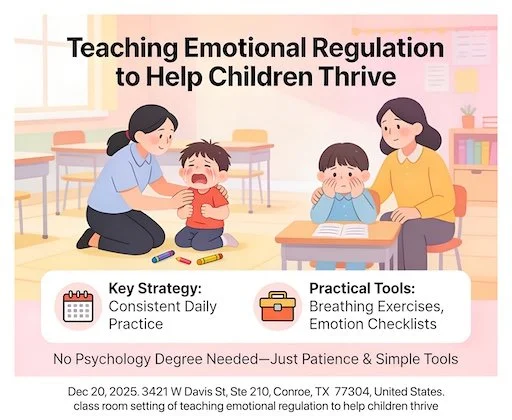
Every parent and teacher has seen a child melt down over a lost crayon or freeze up before a test. Teaching emotional regulation early is one of the most powerful ways to help children learn, relate, and thrive — and it doesn’t require a psychology degree, just consistent strategies and a few practical tools.
Why Emotional Regulation Matters for Children
The role of emotional regulation in child development
Emotional regulation — the ability to notice, understand, and manage feelings — is foundational to learning and relationships. When children can calm themselves after frustration, they can return to tasks, follow instructions, and interact positively with peers. Social-emotional skills support classroom engagement, improve behavior, and make learning more efficient.
- Children who develop self-regulation show better attention, fewer behavior problems, and stronger academic outcomes.
- Educators see improved classroom climate when students use calming strategies and coping skills for kids are practiced regularly.
Long-term benefits of early emotional skills
Research shows social-emotional learning (SEL) programs increase academic performance and reduce behavioral problems. A meta-analysis of SEL interventions found an average 11-percentile-point gain in achievement for students who received SEL instruction (Durlak et al., 2011). Early emotional skills also lower risk for anxiety and depression later in life and promote resilience.
Sources:
- Collaborative for Academic, Social, and Emotional Learning (CASEL):
- Durlak, J.A., et al. (2011). The Impact of Enhancing Students’ Social and Emotional Learning:
Common emotional challenges children face
Children face many emotion triggers depending on age and context:
- Toddlers: frustration at limits, separation anxiety.
- Preschoolers: big feelings about sharing, fear of the dark.
- School-age: peer conflict, test anxiety, transitions.
- Adolescents: identity stress, social pressure.
Understanding typical triggers helps adults prepare effective supports and adopt emotional regulation kids techniques appropriate to developmental stage.
Core Concepts: What Is Emotional Regulation?
Defining emotional regulation in child-friendly terms
Explain it simply: emotional regulation means “noticing how you feel, using ways to calm down, and choosing what to do next.” Distinguish:
- Emotion = inner experience (sad, angry).
- Expression = how a child shows feelings (crying, yelling).
- Behavior = the action that follows (hitting, hugging).
Teaching children to name feelings and select calmer behaviors is a practical foundation.
Emotional intelligence and its components
Emotional intelligence includes:
- Emotional awareness (recognizing feelings).
- Emotional management (calming strategies).
- Social skills and empathy (understanding others).
Activities for emotional intelligence — like perspective-taking games and storytelling — build these components. Integrating these activities into daily routines strengthens emotional vocabulary and regulation.
How mindfulness for emotional regulation fits in
Mindfulness teaches noticing thoughts and bodily sensations without judgment. For kids, mindfulness for emotional regulation translates into short breath exercises, sensory checks, and simple body scans. Regular practice increases awareness and gives children fast tools to lower arousal and focus.
Example: A 3-minute breathing practice before a test reduces anxiety and improves focus, while quick grounding (5-4-3-2-1 sense-list) helps during playground conflicts.
Practical Strategies for Emotional Regulation
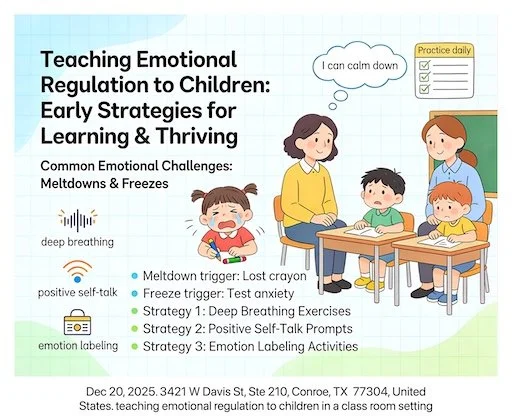
Emotional regulation kids techniques parents can use at home
Parents can implement straightforward, consistent strategies:
- Routines: predictable mornings and bedtimes reduce stress.
- Labeling feelings: “You seem angry. I see your fists.” Naming emotion reduces intensity.
- Validating emotions: “I get that you’re upset — losing that toy is disappointing.”
- Calm-down plan: a simple chart with steps (pause, breathe, choose).
Script for validation + limit:
- Parent: “You’re really mad right now, and I can’t let you hit. Let’s take three deep breaths together, then tell me what you need.”
Practical tip: Use a feelings thermometer (1–5) so kids can tell you how big their emotion feels.
Classroom-ready strategies for teachers
Teachers can use environmental supports and routines:
- Visual supports: feelings charts, morning check-in boards.
- Emotional check-ins: quick thumbs-up/sideways/down, or color cards each morning.
- Predictable transitions: timers, countdowns, and clear cues reduce anxiety.
- Calm corner: a designated space with sensory tools, breathing scripts, and visuals on coping skills.
Classroom script for a check-in:
- Teacher: “Good morning. Today, place your card: green (ready), yellow (a little worried), or red (need help). If red, come to the calm corner after morning work.”
Combining mindfulness, play, and problem-solving
Blend approaches for stronger learning:
- Mindful play: use slow-motion movement games to mix mindfulness with fun.
- Role-play problem-solving: simulate peer conflict and practice I-messages.
- Cooperative games: build social skills and empathy.
Example lesson: After a story about sharing, have students role-play ways to handle taking turns, then practice a 1-minute belly-breathing break.
Activities and Exercises to Teach Emotional Skills
Simple mindfulness exercises for kids
Short, accessible practices:
- Belly breathing (3 counts in, 3 counts out).
- 5-4-3-2-1 grounding: name 5 things you see, 4 you feel, etc.
- Sensory break: hold an ice cube, notice sensations for 30 seconds.
- Body scan: “Wiggle your toes, relax feet, soften legs…”
These are core examples of mindfulness for emotional regulation and can be adapted by age.
Games and role-plays that build emotional intelligence
Activities for emotional intelligence that engage kids:
- Feelings charades: act out a feeling to build recognition.
- Storytelling with “how would you feel?” pauses to prompt empathy.
- Perspective switch: “If Sam says that, why might he feel that way?”
Role-play script for conflict:
- Child A: “I grabbed the marker by accident.”
- Child B: “I felt mad. Next time, can you ask first?” (Coach to use “I feel” statements.)
Creative outlets and movement-based coping skills
Creative expression is therapeutic:
- Art: draw a “big feeling” and then draw a small felt-safe place.
- Music: playlists for calm vs energized moods.
- Movement: short yoga sequences or GoNoodle breaks to reset the nervous system.
Movement and art are powerful complement to verbal strategies; they give children nonverbal tools to process feelings.
Supporting Children Through Strong Emotions
How to respond when a child is overwhelmed
When a child is overwhelmed, the immediate goal is safety, connection, and de-escalation.
- Step 1: Ensure safety (remove sharp objects, create space).
- Step 2: Stay calm; your tone matters more than your words.
- Step 3: Use a short de-escalation script: “I’m here. You’re safe. Let’s breathe together.”
- Step 4: Offer one concrete choice: “Do you want to sit with me or go to the calm corner?”
“When a child is dysregulated, the adult’s job is to be the regulator.” — Emotion coaching principle
Keep expectations minimal until the child is calmer, then revisit skill-building in a neutral moment.
Coaching coping skills for kids in the moment
Simple, replicable scripts help children internalize coping skills for kids:
- Breathing script: “Let’s blow up an imaginary balloon — breathe in through the nose, blow out through the mouth.”
- Naming feelings: “Say: ‘I’m angry.’ Now put your hand over your heart and breathe.”
- Action plan prompt: “Choose one: squeeze this stress ball, draw for two minutes, or step outside for a walk.”
Modeling is essential: show your own calm-down routine so kids see coping modeled.
When to seek additional help
Seek professional support if emotional challenges are persistent or disabling:
- Signs to watch: intense daily tantrums, sudden withdrawal, changes in sleep or appetite, self-harm, or talk of harming others.
- If emotions interfere with school, friendships, or home life for several weeks, consult your pediatrician or school counselor.
- Resources: [Child Mind Institute], [NAMI], and local mental health services. In the U.S., call 988 for crisis support.
Statistics: [According to the CDC, about 1 in 6 U.S. children aged 6–17 experience a mental health disorder each year]
Teaching Emotional Skills: A Long-Term Plan
Age-by-age progression of emotional skills
Realistic milestones and expectations:
Toddlers (1–3 years)
- Skills: basic emotion recognition, simple calming with caregiver help.
- Strategies: redirection, naming feelings, consistent routines.
Preschoolers (3–5 years)
- Skills: increased vocabulary for feelings, beginning self-soothing.
- Strategies: puppet play, simple breathing games, clear consequences.
School-age (6–12 years)
- Skills: problem-solving, perspective-taking, longer self-regulation.
- Strategies: guided reflection after conflicts, journaling, role-plays.
Adolescents (13–18 years)
- Skills: self-awareness, abstract understanding of feelings.
- Strategies: collaborative problem-solving, validating and offering privacy, teaching stress-management tools.
Tailor expectations: development varies widely; what matters is consistent support and practice.
Building a family or classroom emotional curriculum
Create weekly routines that reinforce emotional growth:
- Weekly check-in day (family meeting or class circle).
- Daily micro-practices: 1–3 minute breathing or sensory breaks.
- Reinforcement: praise specific behaviors (“I noticed you used your breathing when you were upset.”).
- Track progress: simple charts, token systems, or short reflections.
Example weekly plan:
Monday: feelings vocabulary activity.
Wednesday: 5-minute mindfulness practice.
Friday: role-play problem-solving.
Calm-Down Plan Template (use as a poster)
- Stop and take 3 belly breaths
- Put feelings on the thermometer (1–5)
- Choose 1: draw for 5 min / 3-minute walk / talk to an adult
- Return and reflect: What helped?
Resources, books, and apps to support practice
Recommended tools for parents and educators:
Books:
- The Whole-Brain Child by Daniel J. Siegel & Tina Payne Bryson
- How to Talk So Kids Will Listen & Listen So Kids Will Talk by Faber & Mazlish
- The Zones of Regulation (Curriculum and tools)
Apps & programs:
- Headspace for Kids — guided mindfulness
- Stop, Breathe & Think Kids — emotional check-ins and breathing
- GoNoodle — movement breaks for classrooms
- Mind Yeti — short mindfulness for kids
Organizations:
- CASEL — social-emotional learning resources: [][3]
- Child Mind Institute — clinical guidance and resources: [][1]
Include a small “calm kit”: stress ball, feelings chart, breathing beads, and a visual script card.
Conclusion
Recap of key techniques and takeaways
Teaching emotional regulation is a blend of consistency, practice, and compassion. The most effective strategies combine:
- Mindfulness for emotional regulation (short breath and grounding practices),
- Activities for emotional intelligence (role-plays, storytelling, feelings charades), and
- Practical coping skills for kids (calm-down plans, sensory tools, and predictable routines).
Adults model regulation, validate feelings, and scaffold skills until children can self-regulate more independently.
Encouragement and next steps
Start small: pick one strategy — a daily 2-minute breathing routine or a feelings check-in — and keep it consistent for two weeks. Communicate with teachers and caregivers so kids experience the same language and supports across settings.
Call-to-action: Try creating a one-page calm-down plan with your child or class this week, and share how it goes with your child’s teacher or a parenting group. If you notice persistent distress, reach out to a pediatrician or school counselor for guidance.
Further reading and support:
- CASEL’s guide to SEL:
- Child Mind Institute resource hub:
You can build emotional resilience — one breath, one check-in, one role-play at a time.