Holistic Mind-Body-Spirit Care: Achieving True Vitality
Self Hypnosis: Mind-Body-Spirit

Mind-Body-Spirit-Wellness-Soul
You’ve likely experienced the frustration of checking your labs and sleeping well, yet still feeling exhausted. This common scenario reveals a flaw in viewing wellness as a checklist of separate parts rather than a single, connected system.
Consider a houseplant with browning leaves; painting them green won't fix the issue, but checking the soil will. Holistic Mind-Body-Spirit Care applies this "upstream" logic, looking for root causes—like stress or environment—rather than just managing "downstream" symptoms.

While standard treatments can miss these connections, a functional medicine vs conventional medicine perspective acknowledges bio-individuality—the fact that your biological needs are unique. Adopting an integrative wellness approach means treating your health as a distinct ecosystem, moving beyond simply not being sick to finding true vitality.
The 'Second Brain' in Your Belly: Using the Gut-Brain Axis to End Emotional Rollercoasters
Have you ever felt "butterflies" before a date or a sudden pit in your stomach upon hearing bad news? We often dismiss these sensations as simple metaphors, but they are actually biological distress signals traveling along the gut-brain axis connection. This two-way information superhighway links your emotional center directly to your digestive tract, meaning your stomach doesn't just process lunch—it processes your stress.
Your skull isn't the only place housing complex neural networks. Your digestive system contains the enteric nervous system, a massive mesh of over 100 million nerve cells lining your gastrointestinal tract. This "second brain" doesn't do algebra or write poetry, but it manages digestion and constantly communicates with your head brain, explaining why emotional turmoil so often manifests as bloating or indigestion.
Surprisingly, about 95% of serotonin—the key hormone that stabilizes mood and happiness—is produced in your belly, not your head. When gut bacteria are out of balance due to processed foods, nutritional psychiatry suggests that serotonin production drops, leading to anxiety or irritability. Feeding your gut with high-fiber foods isn't just about regularity; it is a foundational step in learning how to achieve emotional balance.
Treating your mood might start on your plate, but food is only one input in this complex ecosystem. While nourishing the gut supports chemical balance, we must also address the tension stored in the body's tissues to fully reset the system.
Beyond 'Just Breathe': Somatic Techniques for Real Nervous System Regulation
You might notice that even with a perfect diet, you still feel "wired but tired." This often happens because while we analyze our problems mentally, we ignore the physical energy trapped in our muscles. These psychosomatic symptoms of chronic stress—like a clenched jaw or tight shoulders—are signs that your nervous system is stuck in "survival mode," flooding your body with cortisol long after the threat is gone.
To flip the switch from "fight or flight" back to "rest and digest," we need to speak the body's language. Somatic experiencing for trauma release focuses on physical sensations rather than the story behind the stress. By consciously noticing and releasing tension, you signal to your brain that you are safe, stopping the stress cycle at its physiological source.
You can start sending these safety signals immediately with three simple techniques:
Box Breathing: Inhale, hold, exhale, and hold for four counts each to mechanically slow your heart rate.
Body Scanning: Mentally visit each part of your body from toe to head to identify and soften hidden tension.
5-4-3-2-1 Method: Engage your five senses to ground yourself in the present moment when anxiety spikes.
For deep maintenance, restorative yoga for nervous system regulation offers a powerful reset. Unlike a sweaty gym session, this practice uses props to support the body completely, allowing you to drop into a state of deep relaxation that actively lowers cortisol. Once your nervous system is calm, you are finally primed to make conscious choices about fuel, highlighting the subtle difference between simply eating "healthy" and eating mindfully.
Why 'Healthy' Eating Isn't Always Mindful: Using Nutritional Psychiatry for Mental Clarity
We often assume that a "healthy" diet is simply about counting calories or eating greens, but nutritional psychiatry for mood disorders reveals that food serves as complex information for your brain's operating system. When we rely on quick-fix processed carbohydrates, blood sugar spikes and plummets rapidly, dragging our emotions along for the ride. This biological rollercoaster creates irritability and brain fog, making it nearly impossible to feel balanced regardless of your mindset.

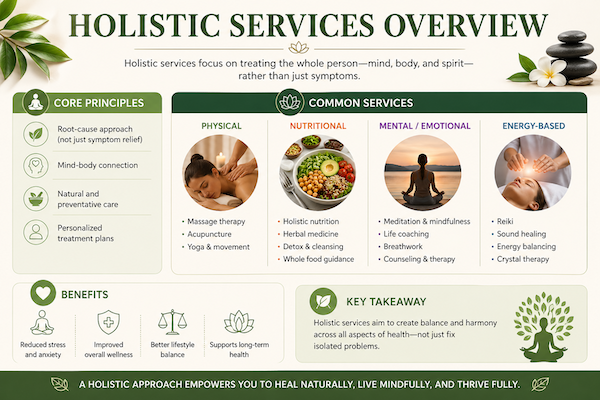
Example Of Holistic Services
Your brain is primarily composed of fat, which means it requires specific fuel—like the omega-3s found in walnuts or salmon—to repair cells and maintain clarity. Unlike the fleeting rush from sugar, these healthy fats provide a steady wave of energy that supports sustained focus and emotional resilience. Stabilizing your internal chemistry also reduces the cortisol spikes that often disrupt rest, significantly improving the impact of sleep on cognitive function by allowing the brain to truly recover overnight.
Changing what you eat is only half the battle; changing how you eat is what maximizes absorption. Applying simple mindfulness techniques for physical healing, such as taking three deep breaths before a meal, shifts your nervous system out of stress mode and actively turns on digestion. This act of slowing down creates the quiet mental space necessary to tune into your intuition, preparing you to reconnect with the deeper sense of purpose we explore in spiritual health.
Reconnecting with Your Spark: Why Spiritual Health is More Than Just Religion
While nutritious food fuels the biological engine, spiritual health determines the direction you travel. This aspect of wellness isn't necessarily about religion or dogma; it is simply the "why" behind your "what"—the deep sense of connection to a purpose, community, or cause larger than your daily to-do list. Without this anchor, even a perfectly healthy body can feel surprisingly heavy.

When this connection fades, we often experience signs of spiritual disconnection like persistent apathy, a feeling of running on "autopilot," or a lack of motivation that sleep doesn't fix. Restoring this internal spark acts as a practical form of self-guided energy healing, shifting your state from drained survival mode back to active engagement. Developing a daily spiritual practice doesn't require a monastery; it only takes moments of intention to ground yourself:
Nature Immersion: A tech-free walk observing natural details.
Creative Expression: Journaling or sketching without judgment.
Community Service: Small acts of kindness for neighbors.
Intentional Silence: Five minutes of quiet reflection.
Reclaiming this sense of purpose is the final pillar to secure before establishing a comprehensive wellness strategy.
Designing Your Sustainable Health Plan: Moving from Band-Aids to Root-Cause Care

Holistic Service Delivery End To End Solutions For Clients
You no longer need to view your health as a checklist of separate chores. By understanding how physical tension, emotional stress, and purpose interact, you can stop chasing individual symptoms and start building whole-system resilience. A single positive shift in one area creates a ripple effect that stabilizes the entire system, proving that small adjustments often yield the biggest rewards.
Start creating a personalized wellness plan today by experimenting with this simple framework:
Body: Audit one daily habit to see if it supports or drains your energy.
Mind: Identify one stress trigger and apply the benefits of mindfulness-based stress reduction, like a breathing pause.
Spirit: Schedule one purposeful activity that connects you to your "why."
True wellness isn't about rigid perfection; it is about fluid balance. By integrating evidence-based complementary therapies into your routine, you cultivate a life defined not just by the absence of illness, but by the presence of vitality and ease.