Where Do Fears Come From?
Where Do Fears Come From? The Psychology and Science Behind Human Fear
Introduction
Fear is one of the most powerful and universal emotions humans experience. Whether it's fear of heights, fear of failure, or fear of the unknown, everyone encounters fear at some point in life. But have you ever wondered where fears come from and why we experience them so strongly?
Fear is not simply a negative emotion—it is a complex response deeply rooted in human biology, psychology, and evolution. In many ways, fear exists to protect us. However, while fear can help us survive dangerous situations, it can also develop into something that limits our potential if we don't understand it.
In this article, we will explore the science and psychology behind fear, including how the brain creates fear, how fears develop through experience, and why some fears seem to exist naturally in humans.
The Biological Purpose of Fear
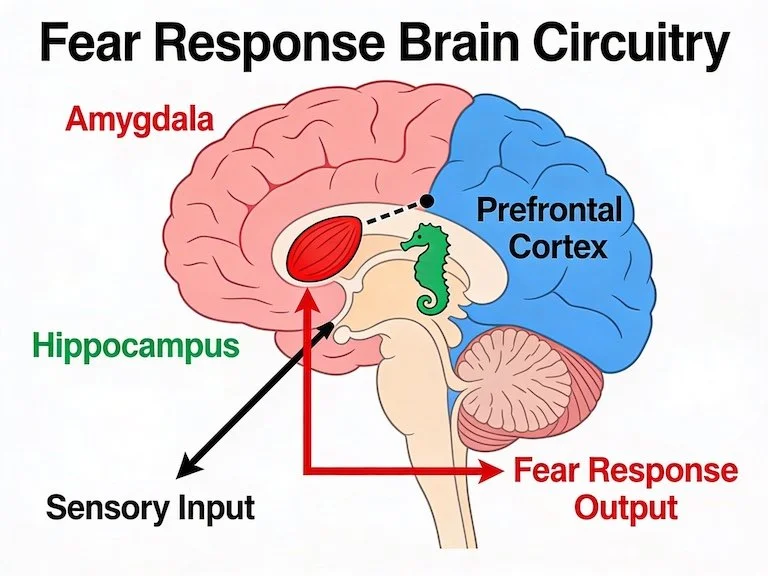
At its core, fear is a survival mechanism. Humans evolved in environments filled with potential dangers such as predators, natural disasters, and hostile environments. In order to survive, the human brain developed a rapid alert system that detects threats and prepares the body to respond immediately.
This system is often referred to as the fight-or-flight response.
When the brain senses danger, several physical reactions happen instantly:
The heart rate increases
Breathing becomes faster
Muscles tighten
Adrenaline is released
Blood flow shifts toward major muscle groups
These reactions prepare the body to either fight the threat or escape from it.
Even though modern life rarely involves predators or physical survival threats, our brains still use the same ancient system when responding to stress, danger, or uncertainty.
The Brain and the Fear Response
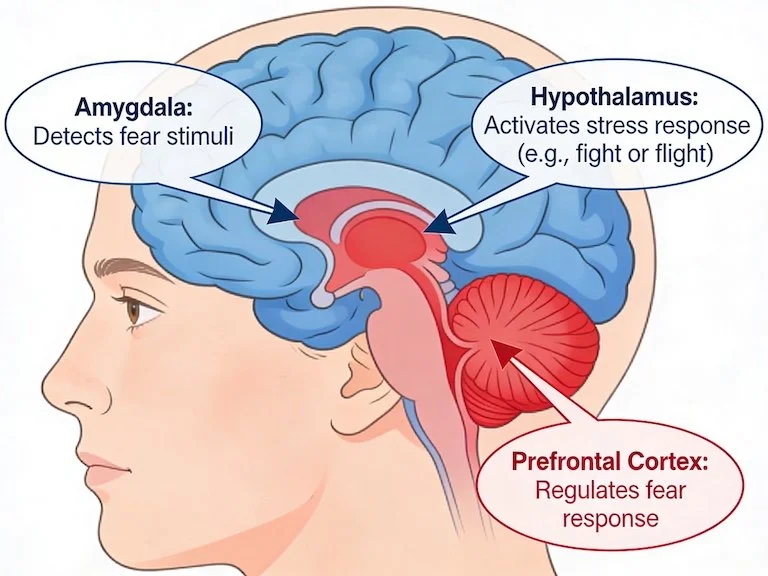
Fear originates primarily in a small part of the brain called the amygdala. This almond-shaped structure acts as the brain’s alarm center.
When the amygdala detects a possible threat, it sends signals to other parts of the brain and body to trigger the fear response.
The process happens extremely quickly and often before we consciously realize what is happening.
The basic steps of the fear response include:
Detection of threat through the senses
Amygdala activation in the brain
Release of stress hormones such as adrenaline and cortisol
Physical preparation for action
This process can occur in fractions of a second, allowing humans to react quickly to potential danger.
Interestingly, the brain sometimes triggers fear even when the threat is not real, which explains why people can feel afraid during movies, nightmares, or imagined scenarios.
Fears That Develop Through Personal Experience
One of the most common ways fears develop is through personal experiences.
When a person has a negative or traumatic experience, the brain learns to associate similar situations with danger. This process is known as fear conditioning.
For example:
A person bitten by a dog may develop a fear of dogs.
Someone who experiences turbulence during a flight might develop a fear of flying.
A student embarrassed during a presentation may develop a fear of public speaking.
The brain remembers the emotional impact of the experience and tries to prevent future harm by triggering fear in similar situations.
While this learning process can protect us from real danger, it can also create fears that are stronger than necessary.
Fears Learned From Other People
Not all fears come from direct experiences. Humans also develop fears by observing others.
This is known as social learning.
Children are especially influenced by the reactions of parents and caregivers. If a child sees a parent react with fear toward something—such as spiders, heights, or thunderstorms—the child may learn to associate that situation with danger.
Examples include:
Children developing fear of insects after seeing adults react strongly to them
Fear of public situations learned from socially anxious parents
Fear of certain environments based on warnings from others
In modern society, fear can also spread through media exposure. News stories, social media, and entertainment often highlight dramatic or dangerous events, which can influence how people perceive risks. Political News StressEffects of watching too much political news on TVAddiction To Social Media
As a result, people may develop fears about situations they have never personally experienced.
Evolutionary Fears Humans Are Born With
Some fears appear to be almost universal across cultures and societies. Researchers believe these fears may be evolutionary, meaning humans are naturally predisposed to fear certain things that historically threatened survival.
Common instinctive fears include:
Heights
Snakes
Spiders
Darkness
Loud noises
Sudden movements
These fears likely evolved because early humans who avoided these dangers were more likely to survive.
For example, people who were cautious around snakes or dangerous cliffs were more likely to stay alive long enough to pass their genes to future generations.
Even today, these fears can appear in young children who have never had negative experiences with these things.
The Role of Imagination and Anticipation
People have a powerful ability that many animals do not: imagination.
While imagination allows us to plan for the future and solve problems, it also means we can experience fear about events that have not yet happened.
This type of fear often appears as worry or anxiety about the future.
Examples include fears about:
Losing a job
Failing at something important
Being rejected by others
Health concerns
Financial uncertainty
In many cases, these fears are not based on immediate threats but rather on imagined possibilities.
Because the brain reacts to imagined threats similarly to real threats, these thoughts can create genuine physical and emotional fear responses.
When Fear Becomes a Problem
Fear itself is not harmful—in fact, it is necessary for survival. However, fear can become problematic when it becomes chronic, overwhelming, or irrational.
In some cases, fear can develop into conditions such as:
These conditions may cause people to avoid certain situations entirely, which can limit opportunities and affect quality of life.
Common signs that fear may be becoming excessive include:
Avoiding everyday situations
Persistent worry
Difficulty concentrating
Physical symptoms such as sweating or rapid heartbeat
Panic attacks
Understanding the origin of fear is often the first step toward managing it effectively.
How People Can Overcome Fear
The good news is that fear can be managed and reduced with the right strategies.
Psychologists often recommend several approaches for overcoming fear:
- Understanding the Fear
Identifying the root cause of fear can make it easier to address. Ask yourself:
When did the fear start?
Was it connected to a specific experience?
Is the threat realistic?
- Gradual Exposure
Gradual exposure involves slowly facing the feared situation in small steps. Over time, the brain learns that the situation is not as dangerous as it originally believed.
This technique is widely used in therapy to treat phobias and anxiety.
- Challenging Negative Thoughts
Fear is often fueled by exaggerated or unrealistic thinking. Learning to challenge these thoughts can reduce fear significantly.
For example, replacing thoughts like:
“Something terrible will happen”
with
“I can handle this situation and learn from it.”
- Relaxation Techniques
Techniques such as deep breathing, meditation, and mindfulness can calm the body's fear response.
These methods help reduce stress hormones and slow down the fight-or-flight reaction.
Why Fear Can Be a Positive Force
Although fear is often seen as negative, it can also be a powerful motivator for growth.
Fear often points toward situations that challenge us to expand our comfort zones.
For example:
Fear of public speaking may push someone to develop communication skills.
Fear of failure may motivate someone to prepare more carefully.
Fear of uncertainty may encourage better planning.
Many successful people credit their achievements to learning how to face fear rather than avoid it.
In this way, fear can become not just a survival tool—but also a catalyst for personal development.
Final Thoughts
Fear is a deeply rooted human emotion shaped by biology, experience, learning, and imagination. It exists primarily to protect us, but it can sometimes grow beyond its original purpose.
By understanding where fears come from, we gain the ability to manage them more effectively.
Instead of viewing fear as something to eliminate, it can be helpful to see it as a signal—one that encourages awareness, preparation, and growth.
When approached with understanding and courage, fear can transform from an obstacle into an opportunity for resilience and personal progress.
When fear becomes persistent and overwhelming, it may develop into anxiety disorders. Learning how to recognize the symptoms early can help you take control. You can read more about how to manage anxiety and stress in everyday life.
How to Manage Anxiety and Stress in Everyday Life
SEO Benefit
Connects fear psychology with mental health content
Builds topical authority around psychology and self-improvement
Gradual exposure is one of the most effective techniques psychologists use to reduce fear responses. If you're interested in practical techniques, check out this guide on how to overcome fear and build confidence.
Many successful people learn to face fear rather than avoid it. Developing a strong mindset can turn fear into motivation. You can learn more about developing a growth mindset for personal success.