How To Support Children with ADHD
Strategies for Supporting Children with ADHD
Practical Guidance for Parents and Caregivers
Understanding ADHD and Its Impact on Family Life
What ADHD is and common symptoms in children
Attention-deficit/hyperactivity disorder (ADHD) is a neurodevelopmental condition that affects attention, impulse control, and activity level. It typically appears in childhood and can continue into adolescence and adulthood. Common symptoms include:
- Difficulty sustaining attention during tasks, especially chores and schoolwork
- Hyperactivity or an inability to sit still
- Impulsive actions, such as interrupting conversations or taking risks
- Trouble following multi-step instructions and organizing materials
The Centers for Disease Control and Prevention (CDC) estimates that roughly 6–10% of school-aged children in the United States are diagnosed with ADHD, depending on the study and diagnostic criteria used. Globally, prevalence estimates range from 5% to 7% in children, highlighting the condition’s commonality across English-speaking countries and beyond.
How symptoms influence learning, play, and relationships:
- Learning: Frequent incomplete assignments, distractibility in class, and variable academic performance.
- Play: Difficulty sharing, rule-following, or maintaining cooperative play.
- Relationships: Strained sibling dynamics, social misunderstanding, and friction with teachers or peers.
The emotional and practical effects of ADHD on caregivers
Caring for a child with ADHD often increases parental stress, sleep disruption, and feelings of isolation. Many caregivers report:
- Elevated daily stress and time spent supervising homework and routines
- Sibling resentment or jealousy when one child needs more attention
- Anxiety about school outcomes or future independence
These realities make ADHD coping techniques for parents essential. Strategies that reduce caregiver burnout—such as predictable routines, access to community resources, and peer support—improve outcomes for the entire family.
Debunking myths and setting realistic expectations
Common misconceptions:
- Myth: "ADHD is just bad parenting."
- Fact: ADHD has biological and genetic components. Parenting matters for management but is not the cause.
- Myth: "Children will outgrow ADHD."
- Fact: Some symptoms change with age; many people continue to show symptoms as adults.
- Myth: "Medication is the only effective treatment."
- Fact: Evidence supports a combination of behavioral therapies, parent training, and medication when appropriate.
Setting realistic goals helps when supporting children with ADHD. Instead of demanding perfection, focus on measurable, time-bound targets: completing one homework task consistently for two weeks, or reducing evening tantrums by using a calming routine. Small, achievable steps build momentum.
Parenting Tips for ADHD: Daily Routines and Home Strategies
Establishing structure and predictable routines
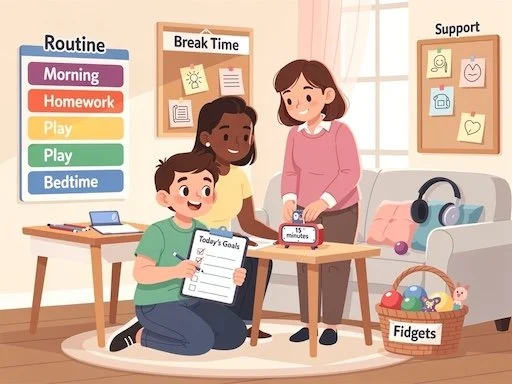
Children with ADHD thrive with consistent structure. Use visual schedules, clearly defined morning/evening routines, and transition warnings to reduce friction.
Practical actions:
- Create a visual schedule by time-block (e.g., 7:00–7:30 am: breakfast; 7:30–8:00 am: pack backpack).
- Use timers and countdowns (five-minute and two-minute warnings) for transitions.
- Keep bedroom, study, and play zones distinct—consistency reduces cognitive load.
Example visual schedule (simple template):
Morning Routine:
1. 7:00 – Wake up, brush teeth, wash face
2. 7:15 – Get dressed
3. 7:30 – Breakfast
4. 7:50 – Backpack check (homework, lunch)
5. 8:00 – Leave for school
These parenting tips for ADHD reduce meltdowns and missed tasks by making expectations clear and predictable.
Positive reinforcement and consistent consequences
Behavior management for ADHD works best when rewards and consequences are clear and consistent.
- Use immediate praise: “You worked on your reading for 15 minutes — great focus!”
- Implement token systems for longer goals (e.g., earn stickers toward a weekend reward).
- Apply natural consequences when safe (e.g., if the homework isn’t done, allow redo with extra support rather than punitive measures).
When to reward vs. correct:
- Reward to reinforce new desirable behaviors.
- Correct with brief, calm feedback focused on the behavior (“Leaving your crayons on the floor is not safe. Let’s put them back in the box.”)
Environmental adjustments to support focus and self-regulation
Small changes at home can yield large benefits:
- Minimize distractions: reduce clutter, use noise-cancelling headphones for study, and keep screens off during homework.
- Organize study areas: clear work surfaces, labeled storage, and checklists for materials.
- Consider sensory needs: fidget tools, standing desks, or soft lighting may help some children self-regulate.
These home modifications are practical ways of supporting children with ADHD and improving daily function.
ADHD Intervention Strategies: Educational and Clinical Approaches
School-based supports and individualized education plans
Collaboration with schools is essential. Parents and caregivers should know their rights and options:
- 504 Plans (U.S.): Provide accommodations such as extra time on tests or preferential seating.
- IEPs: For children who qualify, an Individualized Education Program includes tailored goals and services.
Partner with teachers to translate intervention strategies into the classroom and to ensure consistency between school and home. Regular communication (weekly email updates or a simple home-school notebook) keeps everyone aligned.
Helpful resources:
- CHADD (Children and Adults with Attention-Deficit/Hyperactivity Disorder): CHADD.org
- NHS/NICE guidance (UK): NICE ADHD Guidance
Evidence-based therapies and medical management
Evidence supports a combination of approaches for many families:
- Behavioral therapy and parent training: Highly recommended for young children and as first-line treatment in many cases. Parent skills training teaches consistent routines, praise, and consequences.
- Classroom behavioral interventions: Token economies, brief teacher feedback, and classroom structure.
- Medication: Stimulants (methylphenidate, amphetamines) and non-stimulants (atomoxetine, guanfacine) can be effective for symptom control. Medication decisions should be individualized and guided by pediatricians or child psychiatrists.
The American Academy of Pediatrics (AAP) recommends behavioral interventions for preschoolers and a combined approach for school-aged children (AAP ADHD Guidelines).
Early intervention and monitoring progress
Set measurable goals and track progress:
- Use short-term objectives (e.g., “Complete math homework 4/5 weeknights for 4 weeks”).
- Monitor outcomes with simple charts and weekly reviews with teachers or therapists.
- Adjust strategies as the child grows. Periodic reassessments are important—what works at age 6 may need altering at age 12.
Multi-disciplinary teams (educators, pediatricians, mental health professionals, and occupational therapists) improve comprehensive planning and continuity of care.
Behavior Management for ADHD: Techniques That Work
Clear expectations and effective instructions
Children with ADHD respond best to brief, specific commands.
- Use one-step directions: “Put the book on the shelf” versus multi-part instructions that can overwhelm.
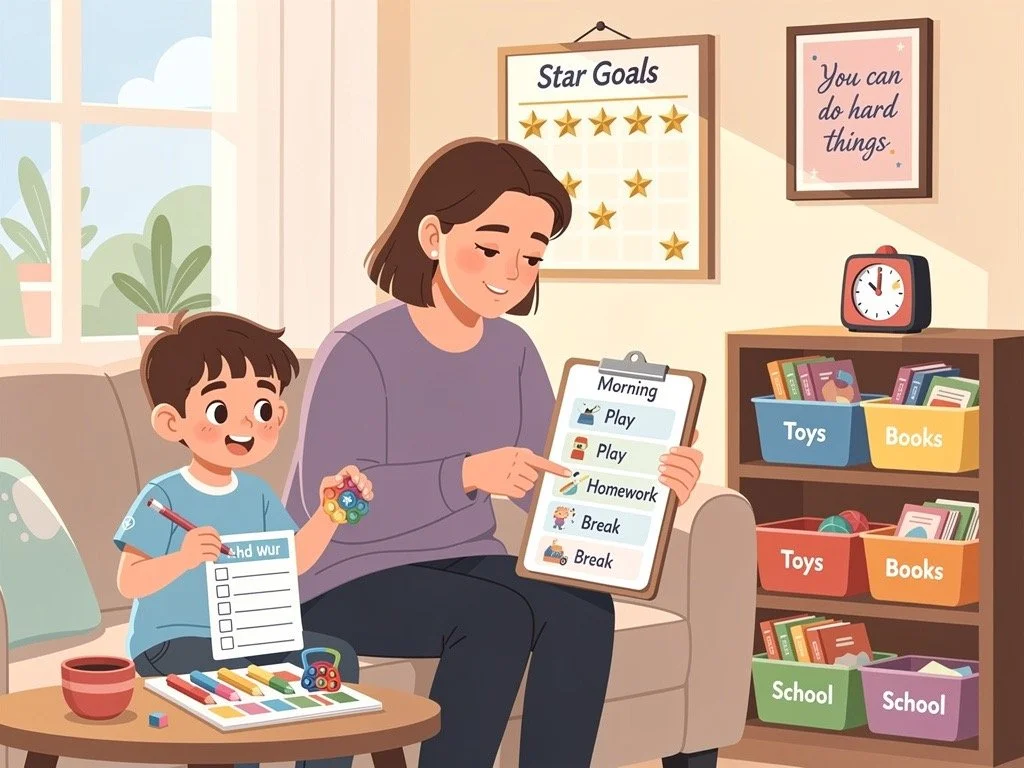
- Pair verbal instructions with visual prompts: checklists, pictures, or labeled bins.
- Use consistent phrasing and routines.
Sample scripts parents can use:
- “When homework time starts, you have 20 minutes to do math. I’ll set the timer.”
- “Hands to yourself. Use your words if you’re upset.”
Preventative strategies and de-escalation methods
Anticipate triggers and intervene early:
- Identify common triggers (hunger, fatigue, changes in routine).
- Use scheduled breaks and physical activity to reset attention.
- Create a calming corner with weighted blankets, soft lighting, and sensory tools.
De-escalation language and steps:
“I see you're upset. Let's take three deep breaths together. After that, we can pick one thing to fix. I’m here to help.”
Stepwise de-escalation:
- Validate feelings briefly.
- Offer a simple, limited choice.
- Remove immediate audience or stimulation.
- Reconnect and problem-solve when calm.
Teaching self-management and executive function skills
Building independence requires intentional teaching:
- Break tasks into small steps; use checklists and timers.
- Teach planning via simple planners or phone reminders for teens.
- Gradually shift responsibility: start with guided completion, move to supervised independence, then full independence.
Age-appropriate suggestions:
- Elementary: 3-step checklists and sticker charts.
- Middle school: shared Google Calendar entries and short timers.
- High school: teach note-taking strategies, time-blocking, and smartphone reminders.
ADHD Support Resources for Families
Community and educational resources
Look locally for:
- School counselors and special education coordinators
- Community mental health centers and parent support groups
- Local chapters of national organizations (CHADD, ADHD Foundation UK)
How to access community programs:
- Contact your school’s special education office for 504/IEP support.
- Search community health centers or local parent networks for workshops and peer groups.
Online tools, apps, and reading materials
Useful tools for routines, focus, and organization:
- Apps: Todoist for task lists, Forest for focus timers, and OurHome for chore management.
- Online guides: CHADD’s parent resources and NICE guidelines for structured care.
- Books: "The Explosive Child" by Ross Greene (sets a collaborative tone), "Taking Charge of ADHD" by Russell Barkley (evidence-informed strategies).
These ADHD support resources help reinforce parenting tips for ADHD and make day-to-day management more manageable.
Professional referrals and crisis assistance
How to find professionals:
- Ask your pediatrician for referrals to child psychologists, psychiatrists, or behavioral therapists.
- Use professional directories (e.g., Psychology Today) to find clinicians who specialize in ADHD.
Crisis and urgent help:
- In the U.S., call 988 for immediate mental health crisis support.
- In the U.K., use NHS urgent mental health helplines or contact emergency services if safety is at risk.
- Always have a safety plan for severe behavioral episodes; discuss crisis plans with your child’s clinician.
ADHD Coping Techniques for Parents: Self-care and Long-term Resilience
Stress management and maintaining parental wellbeing
Caring for your own health is not selfish—it's essential.
Practical self-care:
- Schedule short daily breaks; even 10 minutes of focused breathing helps.
- Join a parent support group to share strategies and reduce isolation.
- Use respite care services or family members to avoid chronic burnout.
Techniques to stay consistent:
- Keep a simple parent checklist for daily routines.
- Use co-parenting agreements to share responsibilities clearly.
Building a support network and advocating effectively
An effective support network includes family, school staff, and community professionals.
Tips for advocacy:
- Keep records: copies of assessments, meeting notes, and emails.
- Prepare for school meetings with clear goals and examples of classroom challenges.
- Set boundaries about when you can help and when you expect independent work.
Communicate respectfully and persistently: documented requests and suggested accommodations help teams act quickly.
Celebrating progress and fostering strengths
A strengths-based approach improves motivation and self-esteem.
- Identify your child’s talents (e.g., creativity, energy, problem-solving).
- Celebrate small wins publicly and privately—progress matters more than perfection.
- Connect interests to learning: a child interested in trains can practice math through train schedules.
Recognizing progress fosters resilience in both children and parents and supports long-term success in helping kids with ADHD.
Conclusion
Key takeaways and next steps
- ADHD is common and treatable; combining ADHD intervention strategies—behavioral therapy, school supports, and medication when appropriate—yields the best outcomes.
- Use routine, visual structure, and positive reinforcement as core parenting tips for ADHD.
- Apply practical behavior management for ADHD: brief instructions, preventative routines, and de-escalation methods.
- Leverage ADHD support resources—local groups, online tools, and professional referrals—to build consistency between home and school.
- Prioritize ADHD coping techniques for parents: self-care, peer support, and advocacy to sustain long-term resilience.
Actionable next steps:
- Create a simple visual routine for the next week and try it for 7 days.
- Schedule a brief meeting with your child’s teacher to discuss one concrete classroom accommodation.
- Join an online parent support group (for example, CHADD or local Facebook groups) and bookmark one app to try for homework routines.
If you found this guide useful, consider sharing it with your child’s school team or community group—small changes build big results. For immediate help or to find a specialist, contact your pediatrician or visit resources like CHADD and NICE.
Call-to-action: Start one small change today—set a five-minute visual routine and observe the difference this week. For more resources and tools, visit the guides from the CDC and CHADD.
Sources:
- Centers for Disease Control and Prevention (CDC). ADHD: Data & Statistics. https://www.cdc.gov/adhd/articles/behavior-therapy-first-young-children.html
- American Academy of Pediatrics. Clinical Practice Guideline (2019). https://pediatrics.aappublications.org/content/144/4/e20192528
- CHADD — Children and Adults with Attention-Deficit/Hyperactivity Disorder. https://chadd.org
- National Institute for Health and Care Excellence (NICE). ADHD guideline (UK). Attention deficit hyperactivity disorder: diagnosis and management