
When to Refer from Hypnotherapy to Psychiatry
When To Refer Hypnotherapy Patients
When to Refer: A Clinician's Decision Guide for Referring from Hypnotherapy to Psychiatry
Introduction
A 34-year-old client who tolerated three regression sessions now reports command voices. The client describes a specific plan for self-harm. Sleep has worsened over the past week. You ended the session and finished a focused risk check.
Now you need clear rules on what to do next.
Decide when to call 911, refer fast to psychiatry, or stabilize.
Then arrange follow-up with specialty care.
Hypnotherapists and related behavioral health clinicians must decide each day if symptoms are safe for hypnotherapy. They must also decide if a psychiatric assessment and medication management are needed. This guide provides a step-by-step triage framework. It includes red-flag thresholds and crisis protocols. It also offers communication templates for medication coordination. You will find ready-to-use referral and follow-up tools. You can use these in U.S. outpatient hypnotherapy practice. This guide explains when to refer hypnotherapy patients. It gives clear steps for urgent and routine referrals. Primary search phrases included: when to refer to psychiatry from therapy. Also: triage checklists for therapy-to-psychiatry referrals. Also: communication templates for clinician referrals. Also: when to refer hypnotherapy patients. Also: referring hypnotherapy clients. Also: referring clients.

1) Pragmatic Clinical Triage Framework: Step-by-Step Decision Guide
Purpose: A repeatable workflow hypnotherapists can use during intake and ongoing care. It helps them decide when to continue treatment and when to refer. It also includes when to refer patients for a psychiatric evaluation.
Studies show high rates of mental health comorbidity in people seeking psychotherapy. Many clients have symptoms that improve with therapy and psychiatric medication, not hypnotherapy alone. According to a large review of research, anxiety and mood disorders often occur together. They often need more than one type of treatment when symptoms are moderate to severe. Treatment may also be needed when symptoms affect daily life (see Sources & Further Reading). For fast clinic use, adopt a standard triage checklist and response-time rules. This keeps referrals objective and easy to defend.
 1.1 Initial screening (intake checklist)
Minimum intake screens to capture common psychiatric needs:
PHQ‑9 (depression) and GAD‑7 (anxiety) at intake and every 4--8 weeks. These are validated for outpatient settings and give concrete symptom scores to track change.
Brief psychosis screen (e.g., ask about hallucinations, paranoid ideation, loss of reality testing).
Dissociation screen (e.g., items from the DES‑II or a short dissociation checklist for regression therapy clients).
Substance-use screen (AUDIT‑C, single-item drug use screening).
Medication history: current psychotropics, prescriber name, last med change, adherence, side-effect complaints.
Safety items: lifetime suicide attempt, recent ideation, self-harm behaviors, current intent/plan, homicidal ideation.
Deliverable: Use a one-page intake triage checklist for hypnotherapy patients. Keep it in the chart. Re-file it when risk changes. Screening instruments like PHQ‑9 and GAD‑7 have robust validity in outpatient settings (see Sources & Further Reading).
Internal link: When trauma drives a client’s issues, add screening to your trauma protocol. Consider referral triggers in your trauma-focused hypnotherapy work: trauma-focused hypnotherapy for PTSD and anxiety. 1.2 Ongoing monitoring & time/response criteria
Turn subjective impressions into objective triggers:
Response thresholds: If PHQ-9 or GAD-7 scores improve by less than 20% after 4 sessions, consider a psychiatry consult.
This applies to brief care with moderate symptoms.
If scores improve by less than 30% after 6 to 8 sessions, consider a psychiatry consult.
This applies to moderate to severe symptoms.
The consult may support a medication review or co-management.Worsening thresholds: Any rise in suicidal thoughts, new psychotic symptoms, new or worse mania, or major functional decline.
If they cannot work or care for themselves, escalate care right away.Documentation prompts: date-stamped scores, interventions used in the session, and client-reported medication adherence. Also note sleep hours per night. Document any substance use since the last visit.
Evidence base: Collaborative care models that combine therapy and psychiatric medication work better for depression and anxiety. They outperform usual care alone (see Cochrane and systematic review citations below). 1.3 Red flags and risk thresholds (urgent vs. routine referral)
Urgent (call or refer within 24 hours):
Active suicidal ideation with intent or specific plan, recent attempt within last 3 months.
Acute psychosis: command hallucinations, disorganized behavior with safety risk.
New-onset mania or severe agitation requiring pharmacologic stabilization.
Severe dissociation causing inability to maintain safety or reality-testing after regression work.
Suspected severe medication adverse effects (e.g., akathisia, serotonin syndrome, signs of lithium toxicity).
Routine (arrange psychiatry consult within 1--4 weeks):
Moderate--severe major depressive disorder not sufficiently responding to 6--8 weeks of psychotherapy or hypnotherapy.
PTSD with persistent hyperarousal and sleep disturbance despite trauma-focused hypnotherapy.
Co-occurring ADHD and anxiety may improve with stimulant evaluation. See when both conditions suggest a need for psychiatric assessment.
When to Urgently Refer (callout)
Immediate 911/ED if imminent danger, loss of self-control, or active plan with means.
Urgent outpatient psychiatry or mobile crisis team for recent attempt, psychosis, or severe agitation.
Routine referral for non-urgent but persistent symptoms or medication questions.
2) Suicidality, Acute Risk, and Crisis Protocols for Hypnotherapy Practices
Managing suicidality in hypnotherapy practice requires scripted rapid assessment, clear escalation pathways, and airtight documentation. National data show suicidal thoughts and attempts are most common among people with mood and substance-use disorders. These disorders are common in outpatient mental health patients (see Sources & Further Reading).

Internal link: Perinatal cases can quickly worsen and may need psychiatry sooner. Review perinatal mental health cases that may need a psychiatry referral for guidance. 2.1 Rapid assessment procedure (script + tools)
A short, standard script reduces clinician drift:
Stop the hypnotic or intervention immediately if safety concerns arise.
Ask direct, time-bound questions: "In the past two weeks, have you had thoughts that you would be better off dead or of hurting yourself?" "Have you had any thoughts about how you would do that? Do you have a plan? Do you have the means now?" "Have you ever tried to harm yourself in the past? When?"
Use clear risk items: intent (none/unclear/definite), plan (no/some/detailed), access to means (no/yes), and protective factors. Include supports and reasons for living.
Frequency: for active ideation, re-check verbally every 24--72 hours until stabilized or transferred to psychiatry.
Deliverable: Keep a phone/email/telehealth escalation script in your EHR or paper chart and train staff on its use. 2.2 Escalation pathways and involuntary-hold/legal considerations (U.S.-centric)
Stepwise actions:
Immediate, serious danger (intent, plan, and means): Call 911.
Ask for police with crisis-trained officers, if available.Arrange transfer to the emergency department. Document who you spoke with.
High risk, but not right away (recent attempt and increasing suicidal thoughts). Contact the local psychiatric crisis team. Or refer the person to the ED. Consider mobile crisis outreach if available.
Non-urgent safety risks: arrange expedited outpatient psychiatry appointment; implement safety planning, increase session frequency, and enlist supports.
Duty to warn/protect and mandatory reporting:
Clinicians have legal and ethical obligations to act on credible threats to self or others. Guidance is codified in state statutes and professional codes (APA/ACA). Always check local law for involuntary-hold criteria and reporting duties.
According to the American Psychological Association ethics resources and most state laws, breaking confidentiality is allowed.
This applies when a client poses an immediate risk to themselves or others.
2.3 Documentation and follow-up best practices
Document key elements:
Exact words used and answers given. The clinician’s risk assessment and summary. Immediate actions taken, like calling 911. Note if family was notified. Note if a safety plan was used. List names and roles of people contacted. Include time and date stamps.
Store a signed safety plan and consent for information-sharing in the chart.
Follow-up: document when client was last seen, who arranged transport or referral, and whether psychiatry accepted referral. Keep copies of ED/psychiatry notes when available.
Deliverable: Crisis documentation template and safety-plan checklist you file under "urgent events."
3) Coordinating Care with Psychiatry: Communication, Roles, and Medication Management
Effective medication coordination cuts duplication, improves safety, and shortens time to symptom control. Collaborative care models consistently demonstrate better outcomes than non-integrated care for depression and anxiety disorders (see Sources & Further Reading). With psychiatry shortages and variable wait times, clear communication makes transfers smoother.

Internal links: Explain hypnotherapy’s role to psychiatrists using resources on how it is used in treatment. Align admin workflows using the clinic billing guide on hypnotherapy workflow and billing considerations. 3.1 What to send in a referral (one-page referral template)
Minimum dataset for a psychiatry consult:
One-paragraph clinical summary (presenting problem, onset, course).
Objective symptom measures: latest PHQ‑9, GAD‑7, dissociation score.
Treatment history: psychotherapies tried (including hypnotherapy techniques and response), session counts, trauma-regression history.
Medication history: current meds, last changes, prescriber contact info, allergies, adverse reactions (e.g., akathisia).
Safety history: prior attempts, current ideation, recent hospitalizations.
Requested question(s): e.g., "Assessment for medication initiation?" or "Shared-care co-management for ongoing pharmacotherapy?"
Signed consent to release information and preferred communication route.
Deliverable: Use a one-page referral template. It must fit on one page. Fax or email it when referring clients to psychiatry.
3.2 Communication templates & consent for shared care
Sample email opening (concise, clinician-to-clinician):
Subject: Psychiatry consult request --- [Client initials, DOB] --- urgent/routine
Body: One-paragraph clinical summary + attached PHQ‑9/GAD‑7 + request and urgency level + contact info + signed consent attached.
Shared-care consent language (brief):
"I authorize [hypnotherapist name] to share clinical and medication information with [psychiatrist name] for the purpose of collaborative care. I understand roles: psychiatrist advises/manages medication; hypnotherapist provides psychotherapy and monitors response and side effects."
Roles and frequency:
Psychiatrist: prescribes and monitors medication, orders labs (e.g., lithium levels), manages complex pharmacology.
Hypnotherapist: reports symptom changes, documents side effects, reinforces safety plan, communicates any emergent changes to prescriber.
Set a communication plan for hypnotherapy referrals.
For example, send a brief secure message after medication changes.
If you co-manage, hold a monthly case review.
3.3 Medication safety & monitoring responsibilities
What hypnotherapists should know and monitor (not prescribe):
Antipsychotics: monitor weight, metabolic symptoms; flag new sedation, extrapyramidal symptoms to prescriber.
Lithium: observa confusionem, tremorem, polyuriam. Praescriptori memento si clientēs nuntiant nauseam vel vomitum. Etiam memento si mutant hydrātātiōnem. Laboratoria, ut gradūs seri, rēnēs, et thyreoidea, sunt officia praescriptoris.
Mood stabilizers (valproate, carbamazepine): monitor for mood change, sedation, signs of hepatic dysfunction --- flag to prescriber.
Benzodiazepines: dependence and overdose risk; flag increased use or misuse.
Antidepressants: watch for emergent suicidality, activation, or serotonin syndrome; supervise safety and report signs immediately.
Cite clinical monitoring guidelines from APA and FDA safety communications for specifics and lab schedules (see Sources & Further Reading).
Deliverable: Keep a medication monitoring checklist next to the client’s chart.
Include items to ask at every visit. Ask about adherence, side effects, new symptoms, and substance use.
4) Managing the Wait: Interim Stabilization Strategies and Telepsychiatry Options
With psychiatric appointments variably delayed in many U.S. regions, hypnotherapists must safely stabilize clients while arranging specialty care. Telepsychiatry has expanded since COVID‑19, providing practical rapid-access alternatives for hypnotherapy patients awaiting evaluation.

Internal link: When ADHD and anxiety happen together, you may need a psychiatry evaluation.
Consider telepsychiatry if local wait times are long.
When ADHD and anxiety happen together, they can signal a need for psychiatric assessment. 4.1 Brief stabilization interventions hypnotherapists can deliver safely
Safe interim actions:
Safety planning (specific steps, 24/7 crisis numbers, removal of means).
Grounding and stabilization hypnotherapy scripts that emphasize present-moment, sensory anchors rather than deep regression if dissociation or suicidality present.
Behavioral activation and structured sleep hygiene to target depression-related functional decline.
Harm-reduction around substance use and referral to detox/harm-reduction services when indicated.
Limits --- do not:
Start or stop prescription medications unless you are a licensed prescriber with an agreement.
Manage severe withdrawal syndromes alone (arrange urgent medical care).
4.2 Telepsychiatry and collaborative-care alternatives
How to arrange:
Identify telepsychiatry services that accept direct referrals or offer urgent consults. Document clinician credentials and state licensure. Psychiatrists must be licensed in the patient’s state for many telehealth visits. Do this for hypnotherapy patients on your caseload.
Use secure telehealth platforms, document consent for telepsychiatry, and set shared notes to be sent to you.
Evidence and uptake:
Telepsychiatry has shown similar diagnostic accuracy and treatment results as in-person care. It also expanded access after COVID. See Health Affairs and CMS reports in Sources & Further Reading.
4.3 When to escalate while waiting (trigger points)
Escalate to urgent care/ED/911 if:
New or intensified psychosis, increased frequency of suicidal ideation or plan, rapid functional decline, or signs of medication toxicity or severe withdrawal.
Always document your decision rationale and who you contacted.
5) Pros, Cons, and Practical Considerations of Referral vs. Continued Hypnotherapy (Multiple Viewpoints)
Deciding to refer has clinical and business implications; weigh both when referring clients from hypnotherapy to psychiatry.
5.1 Clinical pros and cons
Advantages of referral/co-management:
Access to effective medication for moderate--severe depression, PTSD hyperarousal, severe anxiety.
Ongoing safety monitoring and capacity for inpatient care if risk escalates.
Potential for faster symptom stabilization when psychotherapy alone is insufficient.
Disadvantages:
Medication side effects and rare serious adverse events.
Possible fragmentation if communication is poor.
Client reluctance to see psychiatry (stigma, past negative experiences).
Evidence: Combined psychotherapeutic and pharmacologic approaches produce larger symptom reductions for many disorders than either alone in several systematic reviews (see Sources & Further Reading). 5.2 Practice management pros and cons
Pros:
Risk mitigation, clearer legal defensibility, potential for billing coordination for case consultations.
Opportunity for collaborative care arrangements that increase client retention.
Cons:
More administrative overhead (referrals, consent, lab tracking).
Scheduling challenges and potential client dropout during referral waits.
Internal link: Practical billing and workflow tips are available in the hypnotherapy clinic workflow and billing considerations resource. 5.3 Decision aids and when to prioritize which pathway
Decision-tree summary (examples):
Perinatal severe depression: prioritize psychiatry (risk to mother/infant, medication choices with pregnancy implications). See perinatal mental health cases that may require psychiatric referral.
Dissociative destabilization after regression: urgent psychiatry consult if safety impaired.
Persistent moderate depression with functional impairment after 6--8 weeks of hypnotherapy: consider co-management.
6) Best Practices and Key Takeaways
A focused checklist and a handful of operational rules reduce risk and standardize care.
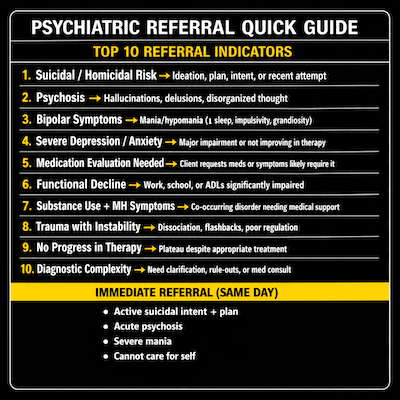
Top 10 Reasons for Psychiatrist Referral
6.1 Concrete best practices checklist
Top 10 practice rules
Screen every new client with PHQ‑9 and GAD‑7 and document baseline.
Ask suicide and psychosis questions routinely and whenever red flags appear.
Use clear time or response triggers to decide when to involve psychiatry. For example, consider psychiatry if symptoms improve by less than 30% after 6 to 8 sessions.
Keep a one-page referral template ready and a signed consent for information-sharing.
Maintain local crisis numbers and a mobile crisis team line accessible to staff.
Never attempt to prescribe or manage complex psychotropics unless credentialed; coordinate with a psychiatrist.
Train staff on escalation scripts and documentation steps.
Use telepsychiatry options for faster access when local waits are long.
Track medication-related safety signals and report ASAP to prescriber.
Review high-risk cases weekly in supervision or with a consulting psychiatrist.
Deliverable: Downloadable "Top 10" quick-reference card for the clinic. 6.2 Quick-reference "What to Send to Psychiatry" one-pager
Essential elements:
Presenting problem + urgency level
Latest PHQ‑9/GAD‑7 and brief dissociation notes
Treatment and medication history
Safety history and current safety plan
Signed consent and preferred contact method
6.3 Implementation tips for small hypnotherapy practices
Practical steps:
Delegate intake screenings to administrative staff with training.
Keep templated referrals and scripts in an editable cloud folder.
Consider a monthly coordination hour with a local psychiatrist for triage phone calls (compensated consultation).
Use billing codes (if applicable) for care coordination or consults per payer rules --- see clinic billing guide for hypnotherapists.
Frequently Asked Questions
Q: When is hypnotherapy alone insufficient and I should refer to psychiatry?
When deciding when to refer hypnotherapy clients, watch for key warning signs.
If the client has active suicidal thoughts with intent or a plan, refer to psychiatry.
Also refer for psychosis, mania, or severe limits in daily functioning.
Refer if the client is pregnant or postpartum with severe depression.
Refer if there is no clear improvement after the agreed number of sessions.
This is usually 4 to 8 sessions, based on starting severity. These are clear clinical triggers for medication evaluation or higher-level care.
Q: What exact information should I include in a referral to a psychiatrist?
Include a one-paragraph clinical summary. Add recent PHQ-9 and GAD-7 scores. Include treatment and medication history. Include safety history, including attempts or suicidal thoughts. State your specific question for the psychiatrist. Include signed consent to share records.
Q: Can I continue hypnotherapy while the client sees a psychiatrist?
Yes---if roles are clarified and consent is documented. Co-management works when the psychiatrist manages medications and labs. You monitor symptoms, side effects, and safety. Share any changes right away.
Q: How do I handle a client with active suicidal ideation during a hypnotherapy session?
Stop the session. Do a focused suicide risk assessment. Use the safety plan. Call emergency services if risk is imminent. Notify supports as appropriate. Document each step. Arrange urgent psychiatric or ED evaluation if needed.
Q: What should hypnotherapists know about medication monitoring responsibilities?
Know common side effects and "red flag" symptoms (e.g., akathisia, confusion, signs of lithium toxicity). Labs and medication adjustments are prescriber duties, but you should promptly report safety concerns and document observations.
Q: How long will it take to get a psychiatry appointment and what do I do meanwhile?
Wait times vary by region; shortages mean waits can be weeks. Use telepsychiatry for faster access and implement interim stabilization strategies (safety plan, grounding, behavioral activation) while arranging consults.
Q: Are there legal risks if I delay referral?
Yes. Failure to escalate clear red flags (imminent risk, psychosis, recent attempt) can expose clinicians to liability for negligence. Document your assessments, decisions, and consultations to demonstrate appropriate action.
Sources & Further Reading
Archer J, Bower P, Gilbody S, et al. "Collaborative care for depression and anxiety problems." Cochrane Database Syst Rev. 2012. According to the Cochrane Review, collaborative care models improve depression and anxiety outcomes compared with usual care.
American Psychiatric Association. "Workforce and Access to Care" and related resources on psychiatrist shortages and access issues. According to the APA, psychiatrist shortages contribute to variable wait times and increased use of telepsychiatry.
CDC WISQARS and SAMHSA data portals. According to CDC and SAMHSA data, suicidal thoughts and attempts are common in people with mood disorders.
They are also common in people with substance use disorders.
This supports quick, low-threshold referrals for people with high-risk symptoms.U.S. Food & Drug Administration (FDA) safety communications and prescribing information pages for psychotropic medications (lithium monitoring, antipsychotic metabolic risks, benzodiazepine dependence warnings). According to FDA guidance, clinicians should monitor for specific medication-related risks and adverse events.
National Center for Complementary and Integrative Health (NCCIH). According to NCCIH, hypnosis may relieve symptoms in some conditions.
These include pain, IBS, and anxiety symptoms.
It is often best used as an add-on in many psychiatric conditions.Health Affairs / CMS reports on telehealth uptake since COVID‑19. According to these reports, telepsychiatry utilization increased markedly during and after the pandemic, improving rapid access in many areas.
American Psychological Association (APA) Ethics Code and related guidance on duty to warn/protect. According to APA ethical guidance, clinicians must act on credible threats and document thoroughly.
Further reading (select):
Cochrane Database Systematic Reviews on collaborative care for depression
APA practice guidelines for bipolar disorder, schizophrenia, and major depression
Conclusion
A standard triage checklist, clear red-flag limits, scripted crisis steps, and one-page referral templates help hypnotherapists.
They support defensible decisions about when to refer clients to psychiatry from therapy. Implement one change this week.
Add the PHQ-9 to your intake, and save the scores.
Prepare a one-page referral template.
Create a shared-care consent form. These steps reduce risk, improve client outcomes, and streamline collaborative care while clarifying when to refer hypnotherapy patients and supporting referring hypnotherapy clients efficiently.
Download the triage checklist, one-page referral template, crisis scripts, and Top 10 quick-reference card. Use them this week to improve safety and continuity for your clients.
Q&A
Question: What red flags mean I must escalate urgently versus make a routine psychiatry referral?
Short answer: Escalate within 24 hours. Consider 911 or the ED. Do this for active suicidal thoughts with intent or a plan. Do this after a recent attempt. Escalate for acute psychosis, such as command hallucinations. Escalate for new-onset mania or severe agitation. Escalate for severe dissociation that impairs safety. Escalate for suspected severe medication side effects. Use 911/ED if there’s imminent danger, loss of self-control, or an active plan with means. Make a routine referral (within 1 to 4 weeks) for moderate to severe depression that persists. Refer for PTSD with ongoing hyperarousal or sleep problems despite treatment. Also refer for ADHD and anxiety together that may benefit from a medication review.
Question: How do I use PHQ-9/GAD-7 and time-to-response rules to decide when to refer from hypnotherapy?
If scores improve by less than 20% after 4 sessions, think about a psychiatry consult.
This applies to brief or moderate symptoms. If the scores improve by less than 30% after 6 to 8 sessions, the symptoms are still moderate to severe.
Consider a medication evaluation.
You can also consider co-managing the patient with another provider. Refer immediately if scores and clinical status worsen (new/worsening suicidality, psychosis, mania, or marked functional decline). Document date-stamped scores, interventions, adherence, sleep, and substance use each visit to support objective decisions.
Question: What exactly should I include in a psychiatry referral, and how do I communicate urgency?
Short answer: Send a one-page summary with a brief clinical synopsis.
Include the presenting problem and its onset and course.
Add the latest PHQ‑9 and GAD‑7 scores and dissociation notes.
List psychotherapy tried, including hypnotherapy methods and response.
Summarize medication history, including current meds and the prescriber.
Note any adverse reactions to medications. Include safety history, including attempts, ideation, and hospitalizations. State your specific question, like “start medication?” or “co-manage?”
Include signed consent to share information. Use a clear subject line (e.g., “Psychiatry consult — [Initials, DOB] — urgent/routine”) and state urgency in the body.
Question: What are my immediate steps if suicidality emerges during a hypnotherapy session?
Short answer: Stop the hypnotic intervention. Do a focused risk assessment. Ask direct questions about intent, plan, means, and past attempts. Also assess protective factors. If there is imminent risk (intent, plan, and means), call 911 for transfer to the ED. If risk is high but not imminent, contact a mobile crisis team. You can also arrange urgent psychiatry. Implement or update a safety plan.
Notify supports as needed.
Document exact statements.
Write your risk formulation.
Record actions taken.
List who you contacted.
Duty to warn or protect applies under state law.
Question: While waiting for psychiatry, what can I do safely—and what should I avoid?
Short answer: Do: implement safety planning with means restriction and crisis numbers. Use grounding and stabilization scripts. Avoid deep regression if dissociation or suicidality is present. Add behavioral activation and sleep hygiene. Address substance-use risks with harm reduction or detox referrals. Arrange telepsychiatry if local waits are long. Don’t start or stop prescription meds without proper prescriptive authority or agreements. Don’t manage severe withdrawal alone.
Instead, monitor for side effects. Escalate urgently if toxicity appears or the person worsens quickly.



In this comprehensive guide, we will explore the root causes of our discontent, how to navigate the heaviest burdens, and actionable ways to embrace self-improvement and emotional strength.